
Quick Answer: Vitrified tiles are the best choice for Jaipur’s 45°C+ summers. Their lower Coefficient of Thermal Expansion (4–6 vs ceramic’s 6–8) and near-zero water absorption make them significantly more resistant to Jaipur’s extreme heat and monsoon humidity cycle.
TABLE OF CONTENT
Why Jaipur’s Summers Destroy the Wrong Flooring Choice
Choosing the right vitrified tiles in Jaipur is not a design decision — it is an engineering decision. Every May in Jaipur, two things are guaranteed: temperatures will breach 45°C, and at least a handful of homeowners in Civil Lines, Vaishali Nagar, and Pratap Nagar will discover — the hard way — that the flooring their contractor installed is cracking, lifting, or discolouring under the heat.
The Rajasthan sun is not a variable to be designed around. It is a constant that must be engineered for. A flooring material that performs beautifully in Mumbai or Bangalore can fail catastrophically in Jaipur’s dry, extreme-heat climate. The thermal expansion coefficient — the rate at which a material expands under heat — is not a number that appears on a showroom brochure. It is, however, the number that determines whether your ₹8-lakh floor survives its third summer.
This guide is written by our design team at Endless Interiors & Construction — a firm that has specified, installed, and maintained flooring across 200+ luxury residential projects in Jaipur. What follows is not a product catalogue. It is a climate-specific technical briefing — the one your contractor should have given you before you selected a tile.
If you are also planning a full home interior, read our complete guide on interior design cost in Jaipur — stone vs modular breakdown included.
Understanding Thermal Expansion: The Science Behind Jaipur's Flooring Failures
When a material heats up, it expands. When it cools, it contracts. In a city where ground-floor surface temperatures can reach 55–60°C during peak summer and drop to 4–8°C in January nights, the cumulative stress of that daily and seasonal cycle — repeated year after year — is immense.
The critical measurement is the Coefficient of Thermal Expansion (CTE), expressed in μm/m·°C (microns of expansion per metre of material per degree Celsius). The higher the CTE, the more the material moves — and the greater the risk of cracking, joint failure, and adhesive bond failure on a Jaipur floor.
Key CTE Values for Jaipur: Ceramic tile: 6–8 μm/m·°C | Vitrified tile (full-body): 4–6 μm/m·°C | Natural Marble: 5–7 μm/m·°C | Natural Granite: 6–8 μm/m·°C | Laminate / Engineered Wood: 14–20 μm/m·°C (HIGH RISK in Jaipur)
The lower the CTE, the more dimensionally stable the material under Jaipur’s thermal swings. Vitrified tiles — fired at higher temperatures and with lower porosity — are inherently more thermally stable than standard ceramic tiles. But the selection does not stop there.
Ceramic vs. Vitrified: The Technical Breakdown
Ceramic Tiles — Where They Work and Where They Fail
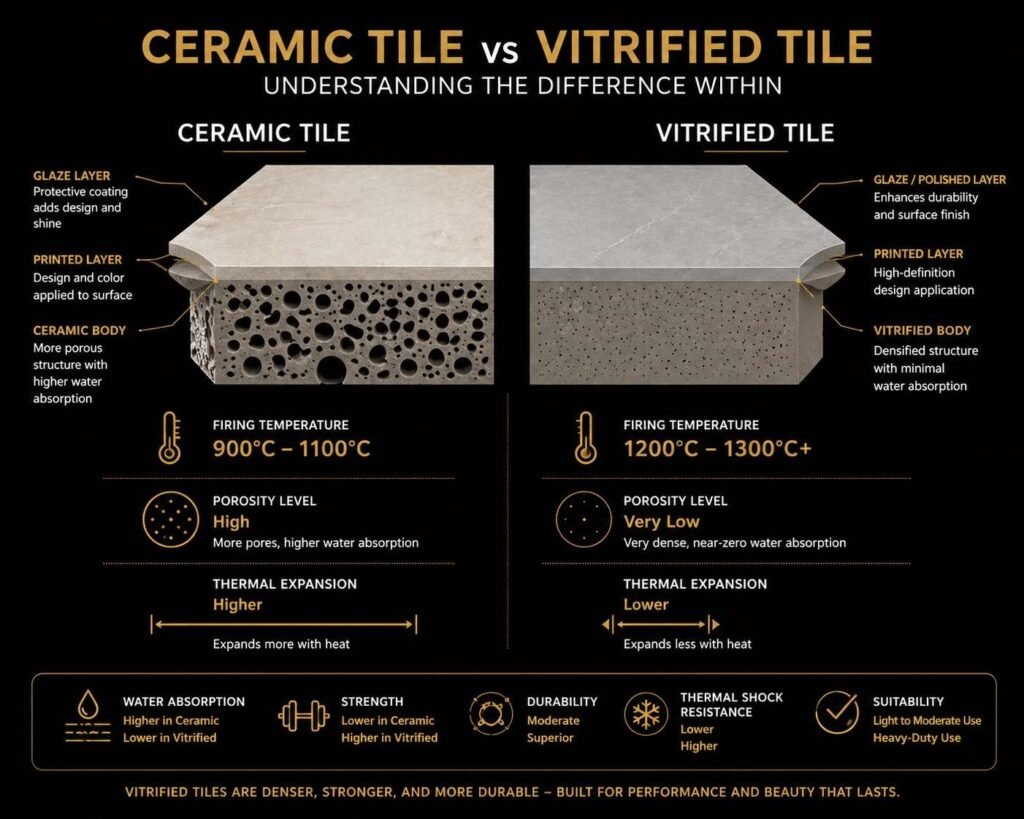
Ceramic tiles are composed of natural clay fired at lower temperatures (1,000–1,150°C). They are more porous, have a higher water absorption rate (above 3%), and carry a higher CTE. In Jaipur’s context:
- Suitable for: Bathrooms, utility areas, and internal wet zones where temperature variance is moderated by enclosed space and lower direct sun exposure.
- Not suitable for: South-facing living rooms, terraces, open courtyards, or ground-floor areas that receive direct afternoon sun from the Rajasthan west and south.
- Failure mode: Grout joint cracking (first sign), followed by tile lippage (edges lifting), and eventually full bond failure from the screed layer.
- 2025 Jaipur cost: ₹35–₹90 per sq. ft. (material only). Labour: ₹30–₹45 per sq. ft.
Vitrified Tiles — The Technical Case for Jaipur
Vitrified tiles are produced by fusing silica and clay at temperatures exceeding 1,200°C, creating a glass-like, near-zero-porosity surface. Water absorption below 0.5% — compared to ceramic’s 3%+ — means far less moisture infiltration, and therefore far less hydraulic pressure during Jaipur’s monsoon-to-summer swing.
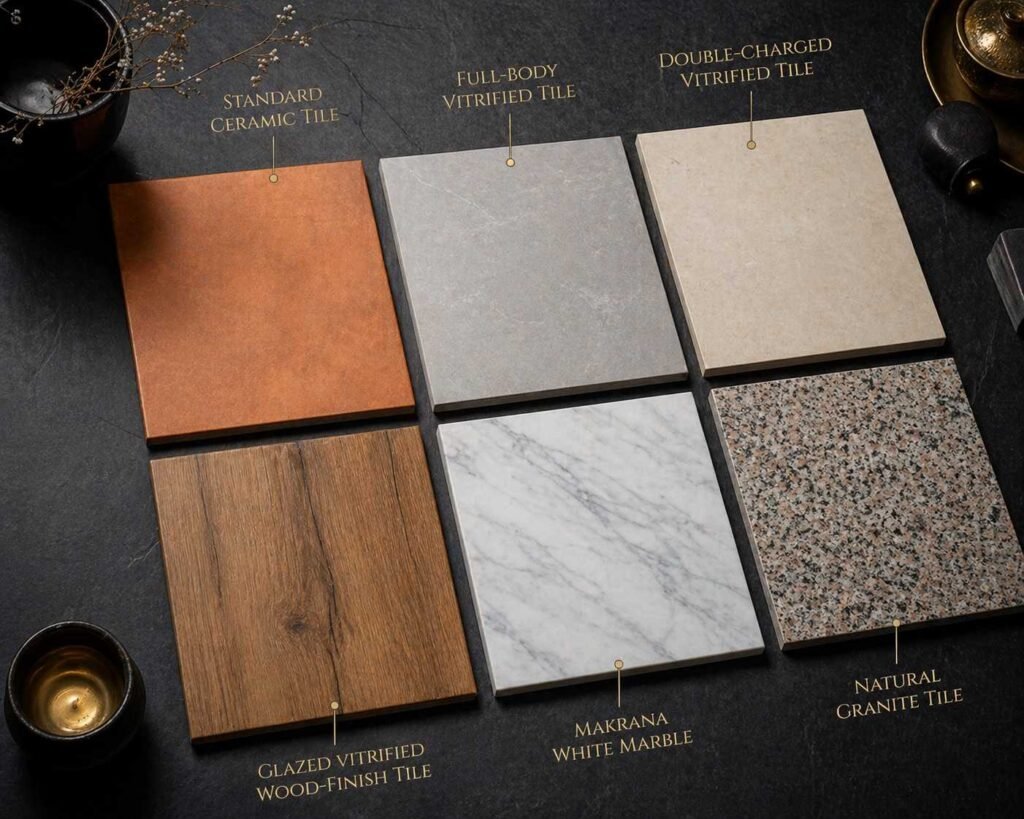
- Full-body vitrified (FBV): Colour and texture runs through the entire tile body. Chips and cracks do not expose a different-coloured core. Ideal for high-traffic luxury villas in Mansarovar and Jagatpura.
- Double-charged vitrified (DCV): Two layers of pigment pressed under high pressure. Excellent surface durability but does show wear in the top layer over 8–12 years in very high-traffic zones.
- GVT / PGVT (Glazed Vitrified): Digital-print surface on a vitrified body. The widest design range — can mimic Makrana marble at a fraction of the cost. Ideal for bedrooms and formal dining in C-Scheme luxury renovations.
- 2025 Jaipur cost: ₹65–₹280 per sq. ft. depending on brand and format (material only). Large format (800×1600mm): ₹180–₹380 per sq. ft. Labour: ₹45–₹80 per sq. ft.
For joinery and cabinet materials that also perform in Jaipur’s climate, read our guide on the best board material for Jaipur interiors.
This is why vitrified tiles in Jaipur have become the standard specification for luxury villa flooring — the climate demands it.
Ceramic vs. Vitrified: Comparative Specification Table
Parameter | Ceramic Tile | Vitrified Tile | Jaipur Verdict |
|---|---|---|---|
Firing Temperature | 1,000–1,150°C | 1,200–1,400°C | Vitrified = more thermally stable |
Water Absorption | >3% | <0.5% | Critical for monsoon-to-summer cycle |
Thermal Expansion (CTE) | 6–8 μm/m·°C | 4–6 μm/m·°C | Vitrified expands less in 45°C+ heat |
Porosity | High | Near-zero | Low porosity = less cracking risk |
Slip Resistance | Moderate | Varies by finish | Both available with anti-slip grades |
Available Formats | Up to 600×600mm | Up to 1200×2400mm | Large format = fewer grout joints |
Material Cost (Jaipur) | ₹35–₹90/sq.ft | ₹65–₹380/sq.ft | Ceramic cheaper upfront |
10-Year Maintenance | Grout resealing needed | Near-zero | Vitrified wins lifecycle cost |
Best Jaipur Use Zone | Bathrooms, utility | Living, bedroom, terrace | Zone-specific selection essential |
The Jaipur-Specific Flooring Strategy: Room by Room
Selecting one tile type for an entire villa is a contractor’s shortcut, not a designer’s decision. In Jaipur’s climate, the correct strategy matches material specification to each zone’s thermal exposure, moisture profile, and usage pattern.
South & West-Facing Living Rooms and Terraces
These receive the most punishing afternoon sun — surfaces can reach 60°C+ in May and June. Full-body vitrified tiles (600×600mm or larger) in light or neutral tones are the only responsible specification. Dark tiles in these zones absorb and retain heat, making rooms uncomfortable and accelerating thermal stress. Use expansion joints every 3–4 metres — a critical installation detail most Jaipur contractors skip. Expansion joint failure is the leading cause of flooring blowouts in Jaipur villas.
Bedrooms in a 4BHK Villa — Jagatpura Context
A 4BHK villa in Jagatpura typically has 4 bedrooms of 180–250 sq. ft. each. These rooms experience moderate thermal exposure and are predominantly used in the evening. Glazed vitrified tiles (GVT) with wood-grain or marble-finish digitally printed surface deliver the luxury aesthetic of natural material at ₹120–₹200 per sq. ft. — significantly below the cost of natural stone — with superior heat performance. For a 1,000 sq. ft. of bedroom flooring: budget ₹1.5–₹2.5 lakhs all-in including labour.
Luxury Renovation in Mansarovar — Heritage Bungalow Floors
Older Mansarovar bungalows (pre-2000 construction) often have kotah stone or basic mosaic floors that homeowners want to upgrade. Here, the critical variable is the existing screed condition. In renovation projects, we always conduct a screed soundness test before new tile specification — hollow screed under new large-format vitrified tiles is a guarantee of future bond failure. If the screed is compromised, budget ₹35–₹55 per sq. ft. for screed replacement before tile costs begin.
Selecting the right vitrified tiles for Jaipur homes requires zone-by-zone analysis — not a single specification for the entire villa.
Installation Standards That Determine Longevity
Even the finest vitrified tile fails if installed incorrectly. In Jaipur’s market, installation quality is as variable as material quality — and most homeowners cannot distinguish good installation from poor until it fails.
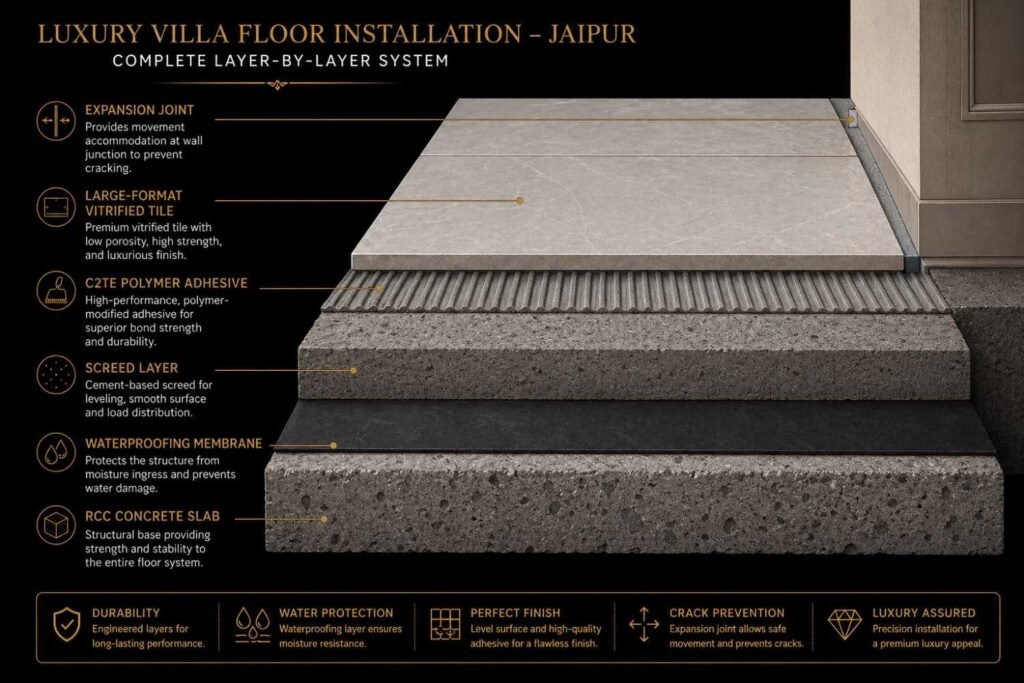
- Adhesive specification: Use C2TE grade polymer-modified tile adhesive for all vitrified tiles above 600×600mm. Standard cement-sand bedding is inadequate for large-format tiles in thermal stress environments.
- Expansion joints: Minimum 3mm joint at every 3m of run, and at all floor-to-wall junctions. Never grout these joints — fill with flexible silicone in a matching colour.
- Back-buttering: Every tile above 600×600mm must be back-buttered (adhesive applied to both tile back and floor) to eliminate hollow spots — the primary cause of cracking under thermal load.
- Shade batching: All tiles for a single room must come from the same production batch (same shade lot number). Batch variation causes visible colour banding that no amount of relaying can correct.
- Curing period: New tile installation must cure for minimum 72 hours before foot traffic and 14 days before heavy furniture placement. In Jaipur’s summer heat, adhesive curing accelerates — enforce this timeline regardless.
Before hiring any contractor for your flooring project, use our complete hiring checklist for Jaipur homeowners to ask the right questions.
C2TE adhesive specifications follow Bureau of Indian Standards IS 13008 guidelines for ceramic tile adhesives in Indian construction.
Why Jaipur Homeowners Choose Endless for Their Vitrified Tile Flooring Specification
Our vitrified tile Jaipur specification process goes through a four-point climate filter before any recommendation is made to a client.
At Endless Interiors & Construction, every flooring specification for a Jaipur project goes through a four-point climate filter before it goes to a client: thermal zone classification of each room, CTE compatibility with expected surface temperature range, installation method validation, and 10-year maintenance cost projection.
We do not allow a Jaipur villa to be specified with the same flooring schedule as a project in Pune or Delhi. The climate is different. The failure modes are different. The specification must be different.
Explore our complete interior design services in Jaipur to understand how we manage every element of your project — flooring included.
Don't Let Jaipur's Summer Decide Your Flooring's Fate
Book a 60-minute Flooring Specification Session with our Principal Designer at Endless Interiors & Construction. We’ll review your villa’s room orientations, existing substrate, and budget — and give you a zone-by-zone flooring schedule built for Jaipur’s climate. No showroom pressure. No generic specifications.
The floor is the largest surface in your home. It deserves a climate-specific decision.
Key Takeaways — Heat-Resistant Flooring in Jaipur
- Vitrified tiles are the superior choice for Jaipur’s 45°C+ summers — lower CTE (4–6 μm/m·°C) means less thermal movement and less cracking risk
- Ceramic tiles are only suitable for enclosed wet zones like bathrooms — not for living rooms, terraces, or south-facing areas in Jaipur
- Full-body vitrified (FBV) is the most durable option for high-traffic luxury villas in Jagatpura and Mansarovar
- Always use C2TE grade polymer-modified adhesive for large-format tiles above 600×600mm — standard cement-sand bedding fails under Jaipur’s thermal stress
- Expansion joints every 3 metres are non-negotiable — their absence is the leading cause of flooring blowouts in Jaipur villas
- Complete vitrified tile flooring for a 4BHK villa in Jaipur: budget ₹5.5–₹10 lakhs all-in for mid-range quality
Frequently Asked Questions
Vitrified tiles are the superior choice for Jaipur's high-temperature climate. Their lower Coefficient of Thermal Expansion (4–6 μm/m·°C versus ceramic's 6–8), near-zero water absorption, and higher firing temperature make them significantly more resistant to the thermal stress caused by Jaipur's 45°C+ summers and wide day-night temperature swings. Ceramic tiles remain appropriate for enclosed wet zones like bathrooms where direct sun exposure is minimal.
Cracking during summer is almost always a thermal expansion failure — caused by either insufficient expansion joints during installation, incorrect adhesive specification, or a material with too high a CTE for Jaipur's climate. If you notice grout cracking first, followed by tile lippage (edges lifting), act immediately. Do not attempt to fill cracks with standard grout — this will fail within one thermal cycle. Contact a qualified flooring specialist for a screed assessment. Early intervention (before bond failure) costs ₹15,000–₹40,000. Full remediation after bond failure costs ₹3–₹8 lakhs.
For a 4BHK villa of approximately 2,500–3,500 sq. ft. in Jaipur, a complete vitrified tile flooring package — including material (mid-range quality at ₹120–₹200/sq.ft), C2TE adhesive, skilled installation labour (₹45–₹80/sq.ft), and expansion joint detailing — typically costs ₹5.5–₹10 lakhs all-in. Large-format premium tiles (800×1600mm+) from brands like Kajaria, Johnson, or imported Italian brands will push the figure to ₹12–₹18 lakhs for the same villa footprint.
Yes, but with conditions. Makrana marble has a CTE of approximately 5–7 μm/m·°C — comparable to full-body vitrified. The real vulnerability of natural marble in Jaipur is not thermal expansion but surface porosity. Polished marble is highly susceptible to etching from mineral-rich Jaipur groundwater, which is used in mopping. A penetrating stone sealer must be applied at installation and reapplied annually. Marble is also significantly cooler underfoot — a genuine comfort advantage in Jaipur summers — but requires a rigorous maintenance commitment that vitrified tile does not.
For a luxury living room, larger formats (800×800mm, 800×1600mm, or 1200×2400mm) deliver a superior aesthetic — fewer grout lines, a more seamless visual field, and a premium appearance. However, large-format tiles require a perfectly level screed (within 3mm across 3 metres), C2TE grade adhesive, and mandatory back-buttering. These installation requirements add ₹15–₹25 per sq. ft. to your labour cost but are non-negotiable. Any contractor proposing large-format tiles without confirming screed level tolerance is setting you up for a costly failure.
Final Thought
Every summer in Jaipur, the same pattern plays out. A homeowner discovers that the floor they chose — based on aesthetics, price, or a contractor’s recommendation — is cracking, lifting, or dulling under the heat. The conversation with the contractor goes nowhere. The remediation costs are significant. And the one piece of information that would have prevented all of it — the Coefficient of Thermal Expansion — was never mentioned in the showroom.
Flooring is the largest surface in your home. It takes more foot traffic, more thermal stress, and more daily punishment than any other finish in the project. It deserves more than a showroom visit and a price comparison.
At Endless Interiors & Construction, we do not allow a Jaipur villa to be specified with the same flooring schedule as a project in a different climate. We classify each room by thermal exposure, match the specification to the environment, validate the installation method, and project the 10-year maintenance cost before a single tile is selected.
If you are planning flooring for a new villa in Jagatpura, renovating a bungalow in Mansarovar, or upgrading an apartment in Vaishali Nagar — start with the specification, not the showroom. Get it right at the beginning, and your floor will still look and perform the same way twenty summers from now.
Book a free Flooring Specification Session — no commitment, just the right answer for your specific home.