
Quick Answer: Sheesham (Dalbergia sissoo) is the superior wood choice for Jaipur’s climate. Its lower shrinkage coefficient, natural termite resistance, and 35–60 year lifecycle outperform plantation Acacia in Jaipur’s extreme dry heat and monsoon humidity cycle. When 20-year total cost of ownership is calculated, Sheesham costs the same or less than Acacia — and arrives as a restorable heirloom.
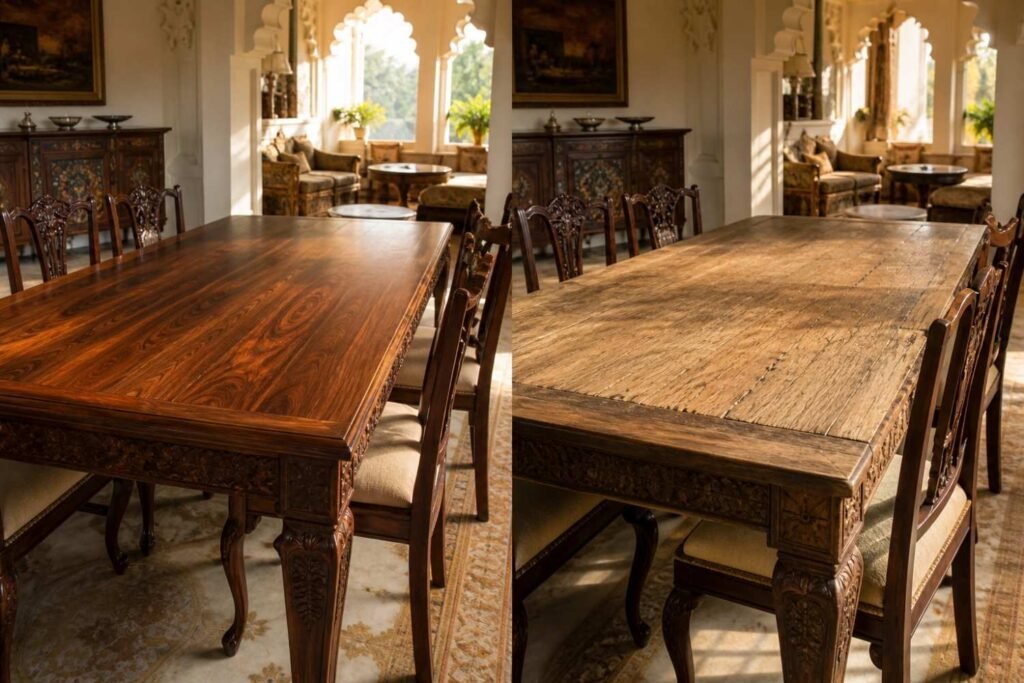
TABLE OF CONTENT
The Dining Table That Told the Truth After Five Years
Choosing between Sheesham vs Acacia in Jaipur is not a style decision — it is a climate and lifecycle decision that will determine whether your furniture looks the same at year seven as it did at handover.
Five years after her new home in Vaishali Nagar was completed, a client called us about her dining table.
It was a beautiful piece. Solid wood, she had been told — sustainably sourced, the furniture shop had assured her, from a responsible supplier. She had paid a premium for it, ₹1.4 lakhs for a ten-seater with matching chairs. She had believed the story the shop told her.
What she was looking at now, five years later, was a table whose surface had developed deep checking — longitudinal cracks along the grain, not dramatic enough to be called splitting, but consistent enough to trap food, trap moisture, and resist every restoration attempt. The chairs had warped subtly at the joints. The colour had faded unevenly, the areas near the west-facing window bleached to a flat, lifeless amber.
She asked us a question we have been asked many times since: ‘Was I sold bad wood?’
The answer was more complicated than yes or no. She had been sold fast-growing plantation timber — likely Acacia auriculiformis, the species most commonly labelled as ‘sustainable teak’ or ‘eco-wood’ in Jaipur’s mid-to-high furniture market. It had not been adequately seasoned for Jaipur’s climate. It had not been treated for the UV intensity of a west-facing room. And critically, no one who sold it to her had conducted a lifecycle analysis — a projection of how that specific wood species would perform under Jaipur’s thermal and humidity conditions over ten to twenty years.
Jaipur’s luxury interior market has a wood sourcing problem. Not a shortage problem — Rajasthan has access to some of India’s finest timber through its proximity to the Sheesham belt of Punjab and Haryana, and its long tradition of master woodworking in Samode, Barmer, and the city’s own furniture cluster. The problem is an information problem.
Homeowners making ₹80-lakh, ₹1.2-crore, ₹2-crore interior investments are selecting wood species — for joinery, for furniture, for flooring, for decorative elements — based on aesthetics, price points, and supplier stories. Almost never based on lifecycle performance data. Almost never with a clear understanding of how Jaipur’s specific climate — the extreme dry heat, the intense UV exposure, the rapid humidity swing from summer to monsoon — will interact with that material over the next decade.
The result, five to ten years after project completion, is a pattern our design team sees repeatedly: surfaces that looked exquisite at handover and look tired, checked, or mismatched at year seven. Materials that were beautiful choices — but wrong choices for Jaipur.
The most expensive wood is not the one with the highest price tag. It is the one you have to replace.
Sheesham vs Acacia in Jaipur: What They Are and How They Perform
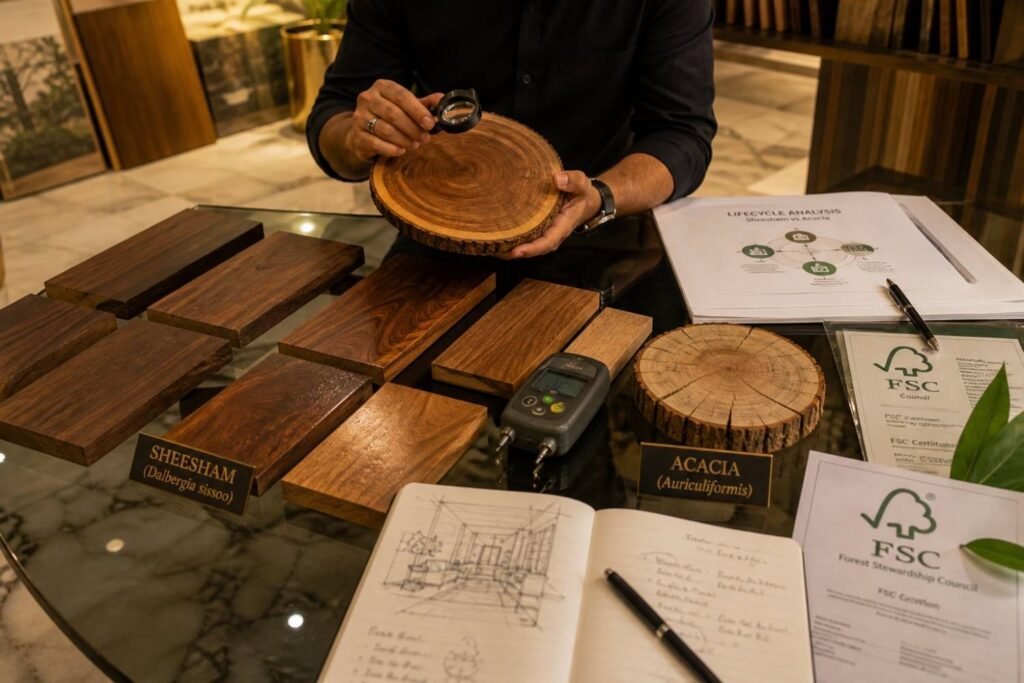
Think of Sheesham and Acacia as two very different kinds of craftsmen. Sheesham is the senior artisan — slow, deliberate, built over decades. Acacia is the ambitious apprentice — fast, eager, capable of good work under the right conditions, but not yet tested by time.
Sheesham (Dalbergia sissoo) — The Rajasthan Wood
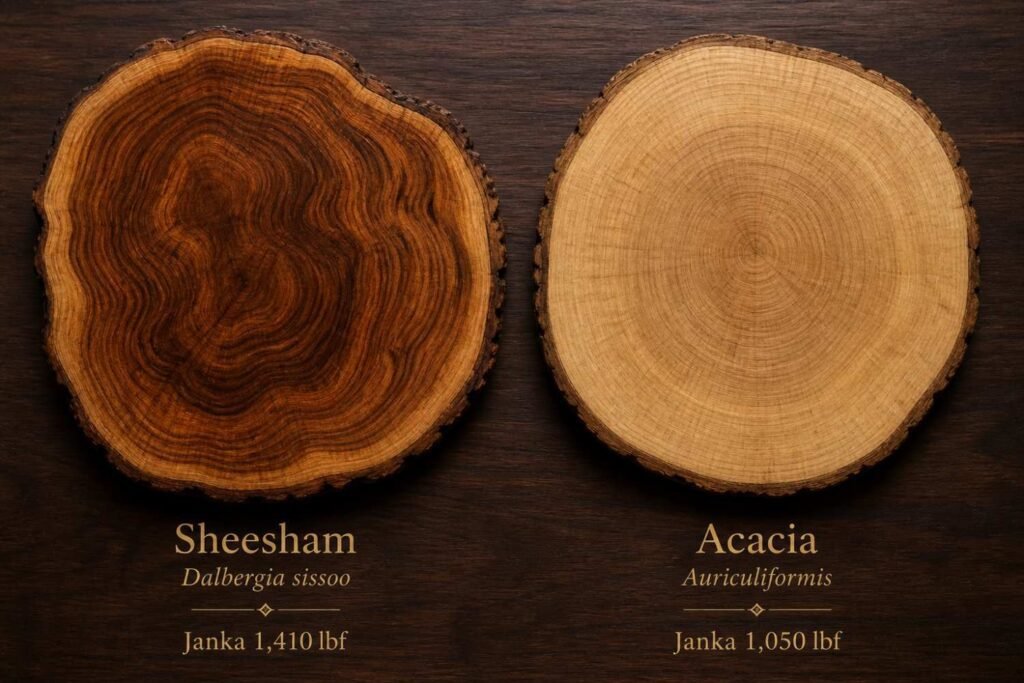
- Janka Hardness: 1,410 lbf — significantly harder than most plantation timbers, resistant to surface denting in high-use environments.
- Natural Durability Class: Class 2–3 (moderately to very durable) — resistant to termite attack and fungal decay without chemical treatment.
- Dimensional Stability: Good — low shrinkage coefficient in Jaipur’s dry heat, minimal checking under the thermal cycle that destroyed our client’s dining table.
- UV Performance: Excellent natural colour stability in shaded and semi-shaded environments. Requires UV-stable oil or lacquer finish for direct west or south sun exposure.
- 2025 Jaipur Market Cost: ₹1,800–₹3,200 per cubic foot (seasoned, grade A). Premium over plantation timber: 40–80%.
- Typical Lifecycle (Jaipur climate, maintained correctly): 35–60 years for structural furniture. Heirloom-grade pieces: 80–120 years.
Acacia (Acacia auriculiformis / Acacia mangium) — The Plantation Alternative
Acacia species — sold under labels including ‘eco-wood’, ‘plantation teak’, ‘sustainable hardwood’, and occasionally simply ‘acacia’ — have become the dominant mid-range furniture timber in Jaipur’s interior market over the past decade. Their appeal is genuine: fast-growing plantation cultivation makes them more readily available and significantly cheaper than old-growth hardwoods. Their FSC certification (where legitimate) gives them genuine sustainability credentials.
The problem is not what Acacia is. The problem is what it is sold as — and what it is not told to be.
- Janka Hardness: 1,000–1,100 lbf — softer than Sheesham, more susceptible to surface marking in high-use environments.
- Natural Durability Class: Class 3–4 (moderately durable to non-durable) — requires chemical treatment for termite and decay resistance in Jaipur’s soil environment.
- Dimensional Stability: Moderate — higher movement coefficient than Sheesham, meaning more checking and joint gap formation under Jaipur’s dry-heat and monsoon humidity swing.
- UV Performance: Poor without treatment — fades rapidly and unevenly under Rajasthan’s high UV index. The bleaching our client’s dining table showed is characteristic.
- 2025 Jaipur Market Cost: ₹900–₹1,600 per cubic foot. Often presented as comparable to Sheesham in showroom settings.
- Typical Lifecycle (Jaipur climate, maintained correctly): 12–22 years for structural furniture. Without treatment: 8–15 years.
Sheesham vs. Acacia: The 20-Year Lifecycle Cost Comparison
This is the analysis that should precede every wood sourcing decision for a Jaipur luxury interior — and almost never does. The table below compares total cost of ownership over 20 years for an equivalent furniture specification in Sheesham versus Acacia.
Cost Factor | Sheesham | Acacia (Untreated) | Acacia (Treated) |
|---|---|---|---|
Initial material cost (10-seater dining set) | ₹1.8–₹2.8L | ₹0.9–₹1.5L | ₹1.1–₹1.8L |
Surface finishing (oil/lacquer, UV-stable) | ₹18,000–₹35,000 | ₹12,000–₹22,000 | ₹18,000–₹32,000 |
Termite treatment (at installation) | Not required (natural resistance) | ₹8,000–₹15,000 | Included in treated cost |
Year 5 maintenance refinishing | ₹8,000–₹15,000 | ₹15,000–₹28,000 | ₹12,000–₹22,000 |
Year 10 major restoration | ₹20,000–₹40,000 | ₹35,000–₹60,000 | ₹28,000–₹50,000 |
Year 15 structural repair / replacement | Unlikely — minor repairs only | Partial replacement likely: ₹50,000–₹1.2L | Possible — joint and surface issues |
Year 20 status | Heirloom-quality, restorable | Often requiring full replacement | Likely requiring significant work |
20-Year Total Cost of Ownership | ₹2.5–₹4.2L | ₹2.2–₹4.5L (replacement scenario) | ₹2.0–₹3.8L |
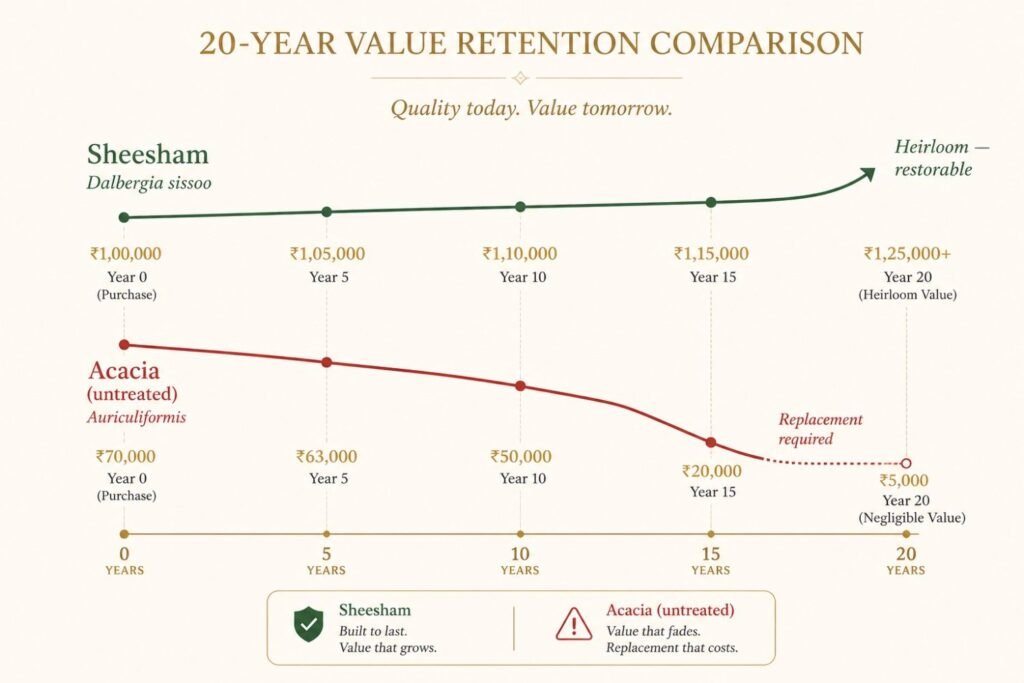
KEY INSIGHT: The 20-year total cost of ownership converges between Sheesham and treated Acacia — but Sheesham arrives at year 20 as a restorable, appreciating heirloom. Acacia arrives requiring significant repair or replacement. The real premium for Sheesham is not in the price tag. It is in what exists at the end of two decades.
For a complete understanding of how material costs fit into your full project budget, read our guide on interior design cost in Jaipur — stone vs modular breakdown included.
How Jaipur's Climate Decides the Wood Question
The lifecycle numbers above are shaped decisively by Jaipur’s specific climate conditions — conditions that are more demanding on wood than almost any other major Indian city. Understanding why helps homeowners make sourcing decisions that go beyond the showroom.
The Dry Heat Problem: Checking and Shrinkage
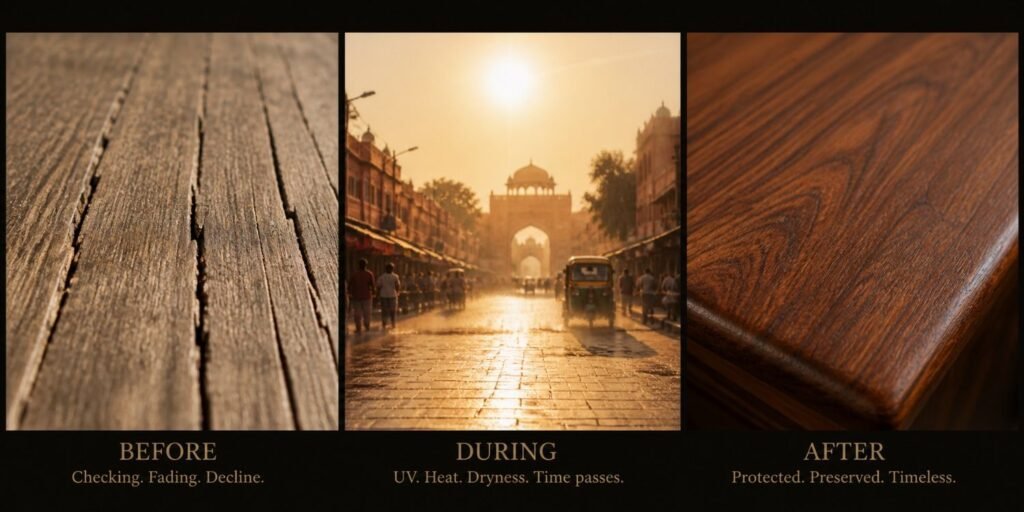
Jaipur’s summer creates relative humidity levels as low as 10–15% during peak heat — among the driest conditions of any major Indian city. At this level of dryness, wood that has not been properly seasoned for this climate loses moisture rapidly and shrinks. The result is checking — the surface cracks our Vaishali Nagar client saw on her dining table after year five.
Sheesham, which has evolved in the same climatic belt, has a lower equilibrium moisture content and a smaller shrinkage coefficient than plantation Acacia species. It moves less. It checks less. In Jaipur’s context, this single characteristic justifies a significant portion of the price premium.
This is why the sheesham vs acacia decision in Jaipur goes far beyond aesthetics — it is determined by how each species responds to Rajasthan’s extreme climate.
The Monsoon Swing: Joint Failure and Swelling
Jaipur’s climate does not stay dry. The monsoon brings a rapid humidity swing — from the 10–15% summer extreme to 70–85% relative humidity in July and August. This is the most punishing condition for wood joinery. Wood expands. Joints that were tight in May become stressed in July. Joints that were stressed in May — already partially failed — become openly loose by August.
The species that handles this swing best is the one with the lowest total dimensional change between the two extremes. Sheesham’s total volumetric shrinkage (12.2%) compares favourably to Acacia auriculiformis (14.8%) — a 20% lower movement range that, in a Jaipur climate context, translates directly to fewer joint failures over a 15–20 year furniture lifecycle.
UV Exposure: The West-Facing Room Problem
Jaipur’s UV index regularly reaches 9–11 (Very High to Extreme) from March through October. West-facing rooms receive the most punishing afternoon exposure. In these rooms, finish specification matters as much as species selection. Without UV-stable finish protection, both Sheesham and Acacia will show colour fade — but Acacia degrades faster and less gracefully, developing the patchy, uneven bleaching that characterised our client’s table.
- For south and west-facing rooms: specify UV-absorbing hard wax oil or UV-stable PU lacquer as the mandatory topcoat on all wood surfaces — Sheesham or Acacia.
- Reapplication schedule in Jaipur: annual light maintenance coat, full recoat every 3–4 years for south/west exposures, every 5–6 years for north/east exposures.
- Cost of UV-stable finish for a 10-seater dining set: ₹8,000–₹15,000. Cost of replacing a UV-degraded Acacia table: ₹90,000–₹1.5 lakhs.
The Sustainability Question: Is Sheesham Actually More Eco-Responsible Than Acacia?
This is the question that furniture showrooms in Jaipur rarely answer clearly — and that many homeowners who want to make responsible choices struggle with.
Acacia’s sustainability credentials are real when the species is grown in certified plantations with responsible harvesting practices. FSC certification (Forest Stewardship Council) on Acacia means the timber comes from a managed forest where growth rate, harvest rate, and environmental impact are monitored. This is genuinely more traceable than much of the Sheesham available in Jaipur’s market — where supply chains are fragmented and chain-of-custody documentation is inconsistent.
The Eco-Responsible Framework for Jaipur: It is not Sheesham vs. Acacia as a sustainability question. It is: certified, correctly seasoned, locally proximate wood with a 35+ year lifecycle vs. any wood that requires replacement in 12–15 years. Replacement is the least sustainable outcome — it doubles the timber consumed, the energy expended, and the waste generated.
At Endless Interiors & Construction, our sourcing protocol for all wood elements requires three simultaneous criteria: certified origin (FSC or equivalent traceability), correct seasoning for Jaipur’s climate (equilibrium moisture content of 8–10%), and lifecycle specification appropriate to the room’s orientation and use. We do not specify a wood species without a lifecycle projection. And we do not recommend Acacia for structural furniture in high-UV or high-thermal-stress environments in Jaipur — regardless of how competitively it is priced.
FSC certification standards are maintained by the Forest Stewardship Council — verify any FSC claim through their official certificate database.
Our wood sourcing protocol is part of every project we take on — explore our complete interior design services in Jaipur to understand the full scope.
For Jaipur homeowners, the sheesham vs acacia Jaipur question ultimately comes down to this: which material will still be serving your home in 20 years?
What the Endless Wood Sourcing Protocol Looks Like in Practice
We did eventually help the Vaishali Nagar client resolve her dining table situation. The table itself could not be saved — the checking had gone too deep into the surface for restoration to be cost-effective. We specified a replacement in Grade A seasoned Sheesham from a verified supplier in Yamunanagar, finished with UV-stable hard wax oil and a two-year maintenance schedule.
The new table cost ₹2.1 lakhs — ₹70,000 more than the original. But it came with a lifecycle projection of 40+ years under Jaipur’s climate, a maintenance schedule that would cost her less than ₹15,000 every five years, and the documented chain of custody that the original purchase had promised and never delivered.
She asked us, before signing off, whether she should feel badly about having been misled the first time. Our answer: the furniture market in Jaipur does not currently give homeowners the information they need to make lifecycle-aware wood sourcing decisions. That is not the homeowner’s failure. It is the market’s. Our job — as the firm that has been working with these materials across Jaipur’s climate for years — is to close that information gap before the purchase, not after the table shows the truth.
The furniture market won't tell you how your wood ages in Jaipur. We will — before you buy.
Wood Sourcing & Lifecycle Consultation — Endless Interiors & Construction
Before you specify a single piece of timber furniture, joinery, or flooring for your Jaipur villa or bungalow, sit with our Principal Designer for a 60-minute Wood Sourcing Session. We’ll review your project’s room orientations, use patterns, and budget — and give you a species-by-species lifecycle projection for Jaipur’s climate. No showroom pressure. No supplier stories. Just the data.
We think in decades. Because that is how long your interior should last.
Key Takeaways — Sheesham vs Acacia Wood for Jaipur Interiors
- Sheesham (Dalbergia sissoo) outperforms Acacia on every lifecycle measure in Jaipur’s climate — lower shrinkage, higher durability, 35–60 year service life versus Acacia’s 12–22 years
- Jaipur’s extreme conditions — 10–15% summer humidity, 70–85% monsoon humidity, UV index 9–11 — make species selection an engineering decision, not a showroom decision
- The 20-year total cost of ownership of Sheesham and treated Acacia converges — but Sheesham arrives as a heirloom while Acacia requires significant repair or replacement
- Always ask for moisture content documentation — wood for Jaipur should be seasoned to 8–10% equilibrium moisture content. Suppliers who cannot provide this should not be trusted
- UV-stable hard wax oil or PU lacquer is mandatory for all wood surfaces in south and west-facing rooms — annual maintenance coat + full recoat every 3–4 years
- Sustainability is a lifecycle question not a certification question — Acacia requiring replacement in 15 years consumes twice the resources of Sheesham lasting 50 years
- Sheesham Grade A seasoned: ₹1,800–₹3,200 per cubic foot. Acacia plantation: ₹900–₹1,600 per cubic foot. The price difference narrows significantly over 20 years
Frequently Asked Questions: Wood Sourcing for Jaipur Luxury Interiors
For structural furniture in Jaipur's climate — dining tables, beds, wardrobes, bookshelves — Grade A seasoned Sheesham (Dalbergia sissoo) is the superior choice on every lifecycle measure. Its lower shrinkage coefficient, higher natural durability, better dimensional stability under Jaipur's dry-heat and monsoon-humidity swing, and significantly longer service life (35–60 years versus Acacia's 12–22 years) justify its 40–80% price premium at the point of purchase. When the 20-year total cost of ownership is calculated — including maintenance, restoration, and likely Acacia replacement costs — Sheesham typically costs the same or less over the full lifecycle.
Seasoning is the controlled drying of timber to an equilibrium moisture content appropriate for its end-use environment. For Jaipur's climate, wood should be seasoned to 8–10% moisture content — matching the city's average equilibrium humidity. Wood sold at higher moisture content (common in unseasoned plantation timber) will dry and shrink after installation, causing checking (surface cracks), joint gaps, and warping. This is the primary cause of the furniture failures we see in Jaipur's 5–8 year post-installation period. Always ask your supplier for the moisture content documentation of your timber. Legitimate Grade A Sheesham suppliers can provide this. Those who cannot should not be trusted.
FSC-certified Acacia from managed plantations carries genuine sustainability credentials — more traceable than much of the Sheesham in Jaipur's market, where supply chain documentation is inconsistent. However, sustainability is a lifecycle question, not a certification question. Acacia that requires replacement after 12–15 years has consumed twice the resources of Sheesham that lasts 50 years. The most sustainable wood sourcing decision for a Jaipur luxury interior is certified origin plus correct climate seasoning plus a lifecycle of 30+ years. Sheesham, correctly sourced and specified, meets all three criteria more reliably than plantation Acacia in Jaipur's demanding climate.
For west-facing rooms in Jaipur — which receive the most intense afternoon UV exposure — specify a UV-stable hard wax oil (e.g., Osmo Polyx-Oil or equivalent) or a UV-absorbing PU lacquer as the mandatory topcoat. Standard teak oil or beeswax finishes, while appropriate for protected interiors, degrade rapidly under Jaipur's UV index (9–11, Very High to Extreme) and offer insufficient protection for direct-sun exposure. Apply a maintenance coat annually and a full recoat every 3–4 years for south and west-facing applications. The annual maintenance cost is ₹3,000–₹8,000 for a standard dining set — a fraction of the cost of UV-damaged surface restoration.
Three verification steps: First, request the species certificate from the supplier — legitimate Grade A Sheesham should be identified by species name (Dalbergia sissoo) and origin region. Second, request the moisture content reading — a calibrated moisture meter test at point of sale should show 8–12%. Any supplier unwilling to conduct this test on request is selling unseasoned or unverified timber. Third, inspect the grain — genuine Sheesham has an interlocked or wavy grain pattern visible on end-grain cuts, distinct from the straighter, more uniform grain of plantation Acacia. At Endless Interiors & Construction, every timber specification we make for a Jaipur project comes with documented origin and moisture content — because that documentation is the foundation of a 40-year furniture warranty.
Final Thought
Every furniture showroom in Jaipur will tell you a story about the wood they are selling. Some of those stories are true. Most are incomplete. None of them include a lifecycle projection for Jaipur’s climate — because a lifecycle projection would make the sale harder, not easier.
The Vaishali Nagar client whose dining table we opened this guide with did not make a bad decision. She made an uninformed one. The information she needed — moisture content, shrinkage coefficient, UV performance under Rajasthan’s index, 20-year cost trajectory — was available. It simply was not given to her.
At Endless Interiors & Construction, we have spent years working with timber in Jaipur’s specific environment. We have seen what Sheesham does at year 30. We have seen what plantation Acacia does at year 7. We have watched the gap between a beautiful handover and a disappointing five-year follow-up — and traced it, almost every time, to a wood sourcing decision made without the right data.
Before you buy a single piece of timber furniture, joinery, or flooring for your Jaipur home — ask the question the showroom will not ask for you: how will this wood perform in this room, under Jaipur’s conditions, in ten years?
If you do not have that answer, we do. Book a free Wood Sourcing Consultation and get the data before the purchase — not after the table tells the truth.
The sheesham vs acacia Jaipur decision starts with the right information — and that is exactly what this guide is for.