
Quick Answer: Protecting a luxury interior in Jaipur from dust storms requires three simultaneous actions — sealing the building envelope, upgrading HVAC to MERV 13 filters, and applying penetrating sealers to natural stone surfaces.
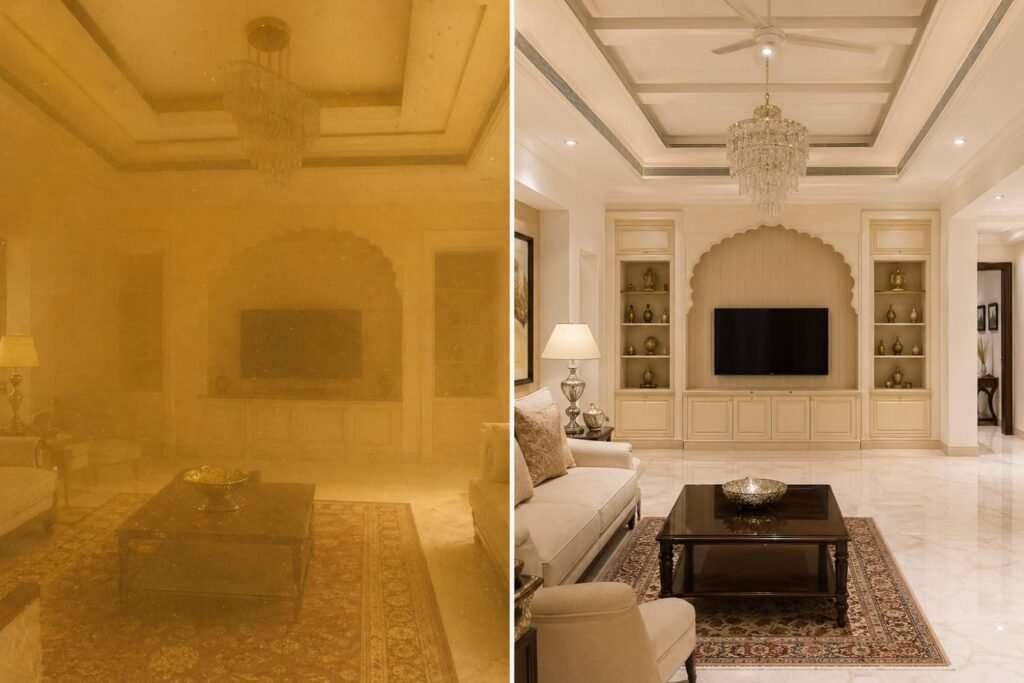
TABLE OF CONTENT
The Afternoon the Aandhi Changed Everything
Dust mitigation in Jaipur is the most overlooked part of any luxury interior project — and the most expensive mistake to fix after the fact.
This guide covers everything you need to know about dust mitigation in Jaipur — from sealing your building envelope to specifying the right HVAC filter and surface sealants for Rajasthan’s climate.
It is 3 PM on a Tuesday in June. A homeowner in Bani Park has just returned from a fortnight in Shimla, where she and her family had escaped the worst of the pre-monsoon heat.
She opens the front door of her recently renovated bungalow — a project she spent eight months and forty-two lakhs completing — and stops.
Everything is grey.
The custom-upholstered sofas. The hand-finished veneer TV unit. The imported Italian marble floor she selected herself, square foot by square foot, on a trip to Kishangarh. The curtains. The art. The inside of the kitchen cabinets.
A single aandhi — one of Rajasthan’s notorious pre-monsoon dust storms — had found its way through every gap, joint, and grille in the house. The HVAC system, which had been left running in auto mode, had done what an inadequately filtered HVAC system always does in
Jaipur: it had distributed the dust evenly and thoroughly through every room in the building.
The cleaning took eleven days. Some of the veneer surfaces never fully recovered. The marble etched where the dust settled into pooled condensation.
This is not an edge case. In Jaipur, dust is not a seasonal inconvenience — it is a structural force that acts on your interior every single day, not just during andhi season. PM10 particulate levels in Jaipur regularly exceed 200–400 μg/m³ during summer — four to eight times the limit set in the WHO air quality guidelines. The city consistently ranks among India’s most dust-affected urban environments.
For a luxury interior, this is a silent destroyer. Dust abrades high-gloss surfaces. It settles into veneer grain and stains it permanently. It degrades HVAC performance by 20–40% within a single season if filters are not specified correctly. It carries moisture in monsoon months — and moisture-laden dust is the primary cause of mould inside modular cabinetry in Jaipur homes.
Most interior firms in Jaipur do not address this. They specify beautiful materials, hand over the keys, and leave the homeowner to discover — as our Bani Park client did — that a luxury interior without a dust mitigation strategy is a depreciating asset.
A luxury interior without a dust mitigation strategy is a depreciating asset.
Understanding Jaipur's Dust Problem: What You're Actually Defending Against
Think of your luxury interior as a precisely made watch. Every component — the veneer, the upholstery, the marble, the finish — works perfectly when the environment is clean. Now imagine dropping that watch in fine sand, every day, for twelve months. The mechanism still runs, but not the way it was designed to. The damage is cumulative, invisible at first, and expensive to repair.
Dust in a Jaipur luxury interior works exactly like that sand. The damage is not dramatic. It does not arrive all at once. It accumulates — in microscopic abrasions on high-gloss surfaces, in the slow degradation of HVAC performance, in the greying of light-coloured fabrics, in the gradual failure of sealed joints.
Defending against it requires three lines of protection, working together. Think of them as the perimeter, the filter, and the seal.
The Three Lines of Defence: Perimeter (Building Envelope Sealing) → Filter (HVAC Specification & Maintenance) → Seal (Surface Treatment & Microfibre Sealants). All three must be in place. Two out of three is not enough.
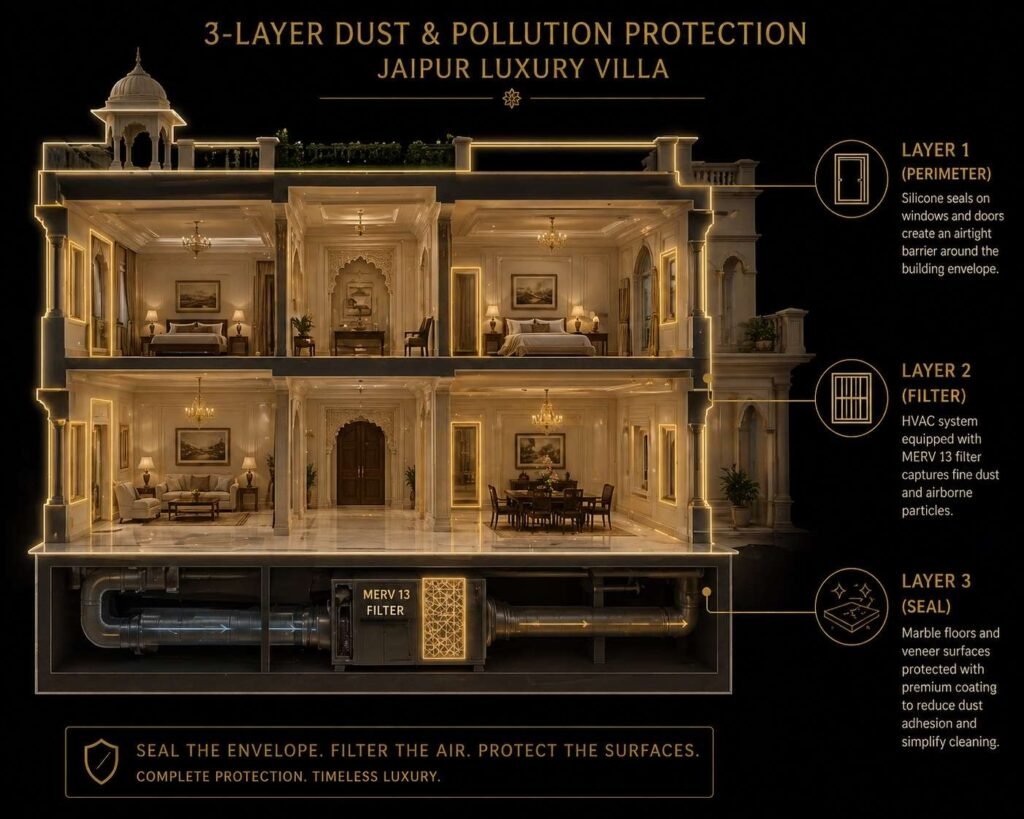
Line 1 — The Perimeter: Sealing the Building Envelope
Before any HVAC filter or surface sealant can do its job, the building envelope must be sealed. In Jaipur’s older residential stock — bungalows in Civil Lines, Mansarovar, and Bani Park — this is where most dust mitigation fails. The building was not designed for Jaipur’s particulate environment. It has gaps.
For heritage havelis and bungalows, building envelope decisions intersect with structural considerations — our seismic retrofitting guide covers this in detail.
Dust Mitigation in Jaipur: Why the Perimeter Fails First
- Window frame-to-wall junction: Seal with weather-resistant silicone (acetoxy-cure or neutral-cure grade). Standard white cement, which most Jaipur contractors use, cracks within 1–2 thermal cycles and becomes a dust entry point.
This is a pattern we see consistently across older residential stock — our interior designers in Civil Lines Jaipur, regularly encounter window junctions sealed with standard white cement that has already cracked within a single summer. - UPVC / aluminium window gaskets: Inspect and replace annually. A degraded gasket on a south-facing window in Mansarovar allows continuous dust infiltration that no HVAC filter can compensate for.
If you’re in a villa or independent bungalow in this corridor, see how we approach dust-sensitive projects through our Mansarovar interior design work. - Door bottom seals: Install brush-type or rubber draft excluders on all exterior doors. During an aandhi, a 5mm gap at the bottom of a door lets in the same volume of dust as a window left ajar.
- Electrical conduit entry points: All conduit penetrations through external walls must be sealed with expanding foam and plastered flush. These pinhole gaps are invisible but cumulatively significant.
- HVAC fresh-air intake position: Fresh-air intakes positioned below 6 feet from ground level draw in disproportionate dust volumes. During installation, specify intakes at a minimum of 8 feet with a pre-filter cowl.
Line 2 — The Filter: Dust Mitigation in Jaipur Starts with HVAC Specification
If you remember only one technical specification from this entire guide, make it this: the MERV rating of your HVAC filter.
MERV (Minimum Efficiency Reporting Value) is the industry standard for air filter performance. It runs from MERV 1 (basic fiberglass — stops large debris) to MERV 16 (hospital-grade HEPA equivalent — stops fine particulates and bacteria). Most HVAC installations in Jaipur residential projects use MERV 6–8 filters — specified for general dust, not for Rajasthan’s PM10-heavy environment.
MERV Rating | Filter Type | Particles Captured | Jaipur Verdict |
|---|---|---|---|
MERV 1–4 | Basic fibreglass | Large debris only | Completely inadequate |
MERV 6–8 | Standard pleated | Dust mites, pollen | Common in Jaipur — insufficient |
MERV 11–12 | High-efficiency pleated | PM10, fine dust, mould spores | Minimum for Jaipur luxury |
MERV 13 | Premium residential | PM2.5, smoke, bacteria | Recommended for aandhi season |
MERV 14–16 | HEPA equivalent | Ultra-fine particulates | Best for heritage/sensitive interiors |
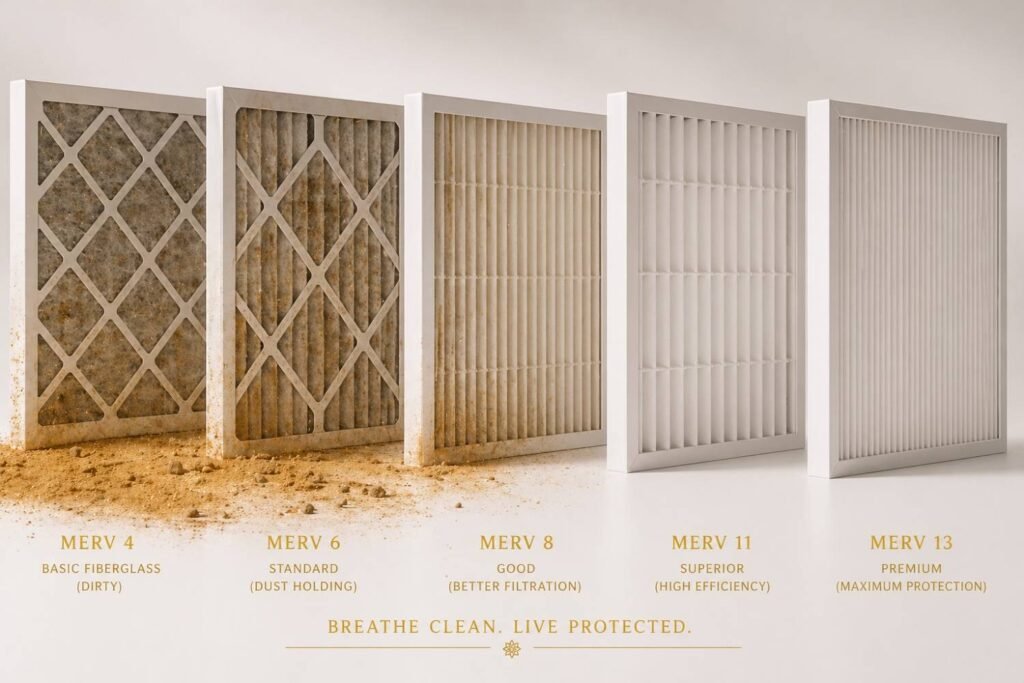
For a luxury villa or bungalow in Jaipur, our specification standard at Endless is MERV 13 as baseline, upgraded to MERV 14 for properties in dustier corridors — Ajmer Road, Tonk Road, or any property within 500 metres of a construction site.
This is particularly relevant for luxury villas in Jagatpura, where proximity to active construction on the eastern periphery means elevated particulate exposure for 8–10 months of the year.
The second variable is filter replacement frequency. A MERV 13 filter rated for 90-day replacement in a standard Indian city requires 45-day replacement in Jaipur during summer months (April–June) and after every major aandhi event. This is not optional — a clogged high-MERV filter performs worse than a clean low-MERV filter, and in humid post-monsoon conditions, it becomes a mould cultivation surface.
Ducted vs. Split System: The Dust Distribution Question
This is the question most Jaipur homeowners do not think to ask until it is too late. A ducted HVAC system — common in larger Jagatpura villas and C-Scheme bungalows — circulates and filters all air centrally. Specify the filter correctly and the entire house benefits. Specify it wrong and the system becomes Jaipur’s most efficient dust distribution network.
Split systems filter only the air in the room they serve. They do not create a whole-home filtration envelope. For maximum dust protection in a split-system home, each unit requires its own filter maintenance schedule — and a portable HEPA air purifier (rated for the room’s square footage) should be considered for bedrooms and formal living areas.
Line 3 — The Seal: Microfibre Sealants and Surface Protection
The third line of defence is the material surface itself. Not every surface can be protected equally — and knowing which surfaces are most vulnerable in a Jaipur interior tells you exactly where to invest in surface treatment.
Natural Stone: The Penetrating Sealer Imperative
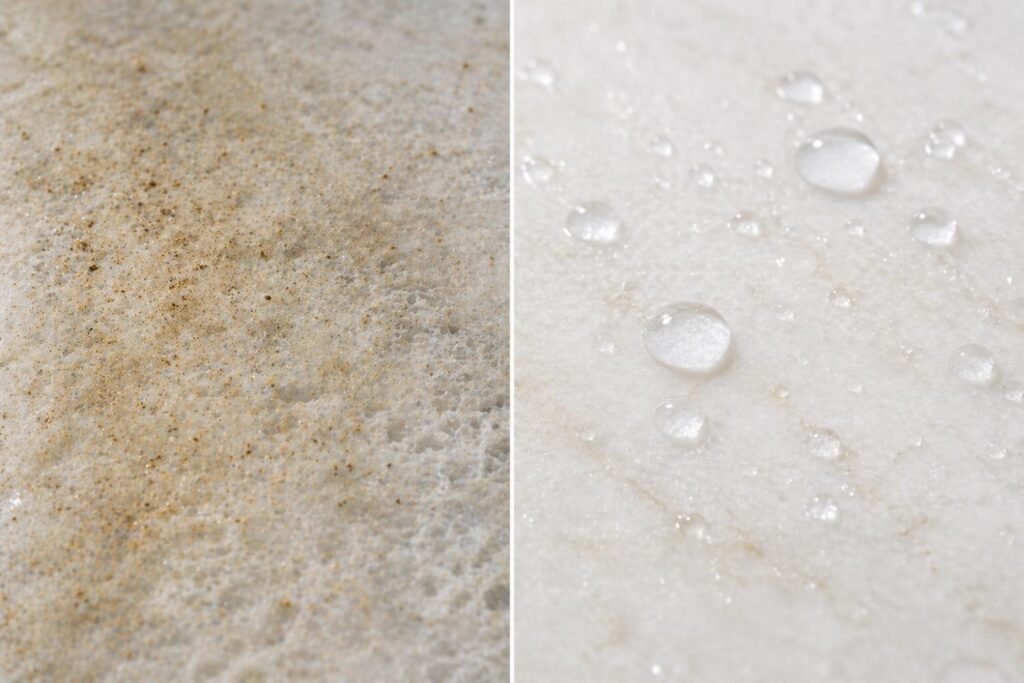
Polished marble and granite — the pride of most Jaipur luxury interiors — are naturally porous at the microscopic level. Dust particles, especially the calcium-rich dust from Jaipur’s soil, embed in these pores and create a permanent grey cast that no amount of cleaning removes. The defence is a high-quality penetrating stone sealer applied at installation and refreshed annually.
- Recommended type: Fluoropolymer-based penetrating sealers (e.g., Lithofin MN Stain-Stop or equivalent). These do not change the stone’s appearance but fill the pore structure against dust and moisture infiltration.
- Application frequency: Once at installation, then annually. In high-traffic areas (entrance foyers, living rooms), twice annually — before summer dust season (March) and before monsoon (June).
- Cost in Jaipur (2025): ₹8–₹18 per sq. ft. for professional application. For a 500 sq. ft. stone floor area: ₹4,000–₹9,000 per application. This is the cheapest insurance your floor will ever have.
Veneer and Wood Surfaces: The PU Topcoat Advantage
In Jaipur’s dust environment, veneer surfaces without a sealed topcoat are particularly vulnerable. Dust settles into the grain, and without a sealed surface, cleaning attempts — especially with damp cloths — push the dust deeper into the wood fibre and cause surface lifting over time.
- Specify PU (Polyurethane) topcoat on all veneer joinery — minimum 3 coats with a final sealing coat. This creates a micro-smooth surface that dust cannot bond with and that can be cleaned with a dry microfibre cloth without surface damage.
- Avoid water-based lacquers in Jaipur’s climate — they absorb moisture from monsoon humidity and can cause surface clouding within 2–3 seasons.
- For open-grain veneer (popular in contemporary Jaipur interiors), specify a grain-filler coat before PU topcoat application — this eliminates the surface texture that traps dust.
HVAC Grille Positioning and Microfibre Pre-Filters
The final — and most overlooked — element of dust protection is the HVAC grille pre-filter. These are inexpensive, replaceable microfibre mesh filters that fit over existing grilles and return-air vents. In Jaipur’s context, they are not optional accessories. They are the last line of defence between the air duct and your interior.
- Specify polyester microfibre pre-filter mesh (20–40 GSM) cut to grille size for every supply and return grille in the home.
- Replace every 30 days during summer and post-monsoon seasons. In a well-sealed home with MERV 13 HVAC, these pre-filters will turn visibly grey within 3–4 weeks — which is exactly the point. Every grey pre-filter is dust that is not on your veneer or your marble.
- Cost: ₹200–₹500 per grille per season. The cheapest component of the entire dust mitigation system — and the most visible indicator of whether the system is working.
What the Endless Dust Mitigation Protocol Looks Like in Practice
When we took on the Bani Park bungalow renovation — the same home we described at the beginning of this guide — the brief was similar to many of our C-Scheme bungalow renovation projects: a beautifully finished interior with no dust mitigation built into the original specification.
The original project had none of these addressed. The HVAC was running MERV 8 filters on a dusty Jaipur corridor. The marble had been installed without a penetrating sealer. The veneer joinery had a water-based lacquer that was already showing early-stage clouding.
The remediation scope — sealing, filter upgrade, stone treatment, veneer recoat — cost ₹2.4 lakhs. It took three weeks. The original interior had cost forty-two lakhs. For 5.7% of the project value, the dust mitigation protocol that should have been in place from day one was finally installed.
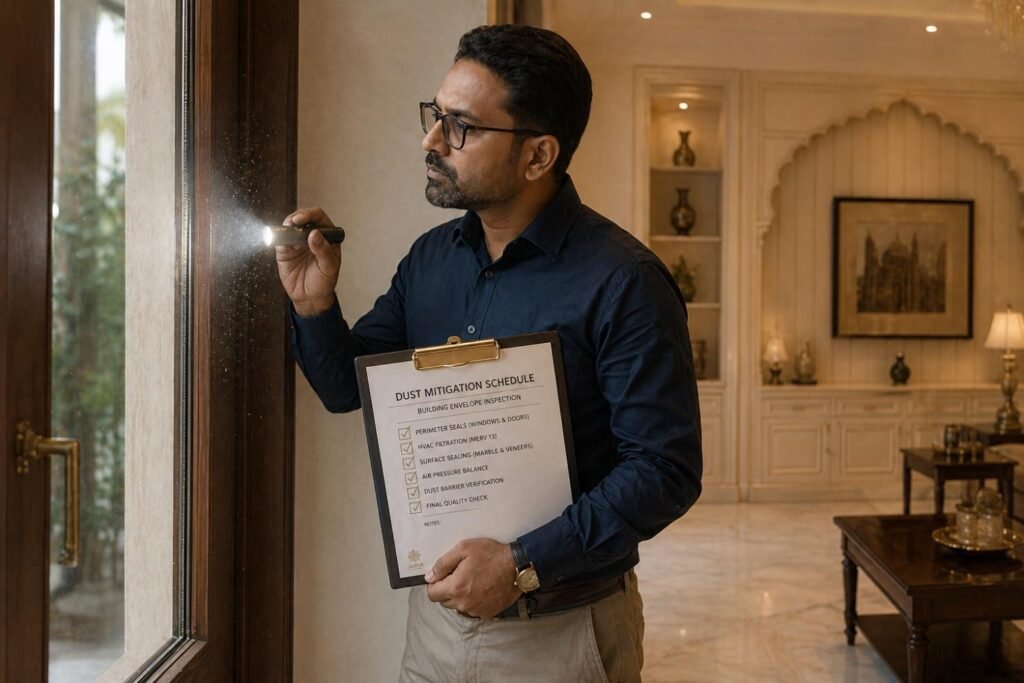
At Endless Interiors & Construction, every project we take on includes a Dust Mitigation Schedule as a formal project deliverable — not an afterthought, not an optional add-on. It includes building envelope specification, HVAC filter grade and replacement calendar, stone sealing schedule, and surface protection specification for every material in the project.
A luxury interior without a dust mitigation strategy is a depreciating asset.
Book a Dust Mitigation Audit with Endless Interiors & Construction
Ready to protect your investment before the next aandhi? Get a Free Consultation with our Principal Designer — we’ll review your building envelope, HVAC spec, and surface treatments in one site visit.
The next dust storm will arrive. The only question is whether your interior is ready for it.
Key Takeaways — Dust Mitigation for Jaipur Luxury Interiors
- Jaipur’s PM10 levels regularly hit 200–400 μg/m³ in summer — 4–8× the WHO safe limit. A luxury interior without dust mitigation is a depreciating asset.
- Three lines of protection must work together: building envelope sealing → HVAC filtration → surface sealants. Any one alone is insufficient.
- Specify minimum MERV 13 HVAC filters for Jaipur luxury interiors. Standard MERV 6–8 (the default from most contractors) is inadequate for Rajasthan’s dust load.
- Replace filters every 45 days during peak season (March–June) and after every major aandhi — not the manufacturer’s 90-day standard.
- All natural stone must be sealed with a fluoropolymer penetrating sealer at installation and refreshed annually. Cost: ₹4,000–₹9,000 per application for 500 sq. ft. — the cheapest insurance your floor will have.
- PU topcoat (minimum 3 coats) on all veneer joinery prevents grain staining. Avoid water-based lacquers in Jaipur’s monsoon climate.
- Microfibre pre-filter mesh on HVAC grilles costs ₹200–₹500 per grille per season. Every grey pre-filter is dust that’s not on your marble.
- A complete Dust Mitigation Protocol for a ₹40-lakh interior costs ₹2–₹4 lakhs upfront. Remediation after damage costs the same — or more.
Frequently Asked Questions - Dust Proofing Interiors in Jaipur
Effective dust protection for a Jaipur luxury interior requires three simultaneous lines of defence. First, seal the building envelope — all window frame junctions, door bottom gaps, and conduit penetrations using weather-resistant silicone and brush-type draft excluders. Second, upgrade your HVAC filter to minimum MERV 13 grade and replace every 45 days during summer months. Third, treat all natural stone with a fluoropolymer penetrating sealer and specify PU topcoat on all veneer joinery. All three must be in place — any one alone is insufficient.
A minimum of MERV 13 is our recommended standard for Jaipur luxury interiors. MERV 13 captures PM10 particulates, fine dust, mould spores, and PM2.5 particles — the primary airborne threats in Jaipur's environment. Properties near construction sites, Ajmer Road, or Tonk Road should consider MERV 14. Standard MERV 6–8 filters, which most Jaipur HVAC contractors install by default, are inadequate for Rajasthan's dust load and should be upgraded immediately..
In the context of Jaipur interior protection, microfibre sealant refers to two distinct applications: HVAC grille microfibre pre-filter mesh (polyester mesh fitted over supply and return grilles to capture dust before it enters the room) and surface-applied penetrating sealers for natural stone and porous surfaces. Both are recommended for any Jaipur luxury interior with natural stone flooring or premium veneer joinery. The combined cost is minimal — typically ₹15,000–₹35,000 for a full villa — relative to the material value they protect.
In Jaipur's climate, standard manufacturer replacement intervals (typically 90 days) are insufficient. Our recommended schedule: every 45 days during peak dust season (March–June), every 60 days during monsoon and post-monsoon months (July–October), and every 90 days during the relatively cleaner winter months (November–February). After every major aandhi event, inspect filters regardless of schedule — if visibly grey or clogged, replace immediately. A clogged high-MERV filter performs below a clean low-MERV filter and in humid conditions can cultivate mould.
Yes — and the damage is cumulative and often irreversible. Dust in Jaipur's environment contains calcium carbonate particles from the soil that are mildly abrasive on polished surfaces, gradually dulling high-gloss marble and lacquered veneer. Dust settling into unsealed wood grain causes permanent staining that cleaning cannot remove. Moisture-laden dust during monsoon months creates conditions for mould growth inside modular cabinetry. The financial case is clear: dust mitigation for a ₹40-lakh interior costs ₹2–₹4 lakhs to implement correctly at the outset. Remediation after damage costs the same or more — and some damage, particularly to veneer grain and polished marble, cannot be fully reversed.
Final Thought
Every summer in Jaipur, a version of the same story plays out. A homeowner returns to a renovated home — eight months of planning, forty lakhs of investment — and finds everything grey. The aandhi came, the HVAC distributed the dust, and a luxury interior became a cleaning project.
The damage is rarely catastrophic on day one. It is cumulative. A polished marble floor that looked perfect in December begins to lose its sheen by May. Veneer joinery that cleaned up fine in the first season starts staining by the third. The HVAC that was performing at 95% efficiency in October is working at 60% by June.
Dust mitigation in Jaipur is not an optional upgrade. It is a fundamental part of designing for this climate — the same way thermal insulation is fundamental in a cold-weather build. A luxury interior designed without it is not fully designed.
At Endless Interiors & Construction, the Dust Mitigation Schedule is a formal project deliverable on every Jaipur project we take on. Not an afterthought. Not a conversation for after handover. It is part of the specification — alongside the material schedule, the electrical layout, and the joinery drawings.
If you’re planning a new interior, renovating an existing home, or simply unsure whether your current home is protected — a Dust Mitigation Audit takes one site visit and gives you a clear answer before the next aandhi makes the decision for you.
Book your free Dust Mitigation Audit →
Before you plan anything, take a look at our completed projects — each one includes a full Dust Mitigation Schedule as a formal deliverable.